Missouri's Oldest Building Style
“When you hear about the development of the nation, you hear a lot about the 13 colonies. When you hear about the history of Missouri, you hear about Lewis and Clark. We were French and Spanish and Native American. There were things going on here.” - Robert Mueller
Introduction:
Most Americans picture a log cabin and imagine the same thing: horizontal timbers, notched corners, a frontier silhouette. But Missouri's oldest surviving building tradition looks nothing like that image. In Ste. Geneviève, French colonial builders placed hand-hewn logs vertically - cedar timbers standing upright in the earth, their gaps sealed with a mixture of mud, sticks, and horsehair called bousillage. This construction method, known as poteaux-en-terre, predates American independence itself. Three of the five remaining examples in North America still stand in this small Mississippi River town, now preserved as part of Ste. Geneviève National Historical Park.
Of the five poteaux-en-terre structures known to survive on the entire continent, three stand in a single Missouri town - a concentration of living history unmatched anywhere in the United States.
Missouri's Oldest Building Style Isn't What You Think
When most Americans picture early frontier homes, they imagine the classic log cabin - the kind associated with Abraham Lincoln and the westward expansion. But Missouri's earliest European settlers built something entirely different, and far older in origin.
French colonists who arrived in the Mississippi River Valley in the 1700s brought with them a building technique called poteaux-en-terre, meaning "posts in the earth." Rather than stacking horizontal logs, they drove heavy cedar or oak timbers directly into the ground to form the walls of their homes - a method rooted in medieval French construction and adapted for Missouri's demanding climate. The gaps between the timbers were filled with bousillage, a mixture of clay, straw, animal hair, and sometimes crushed shell that insulated against both the brutal heat of Missouri summers and the bitter cold of winter.
These homes featured another distinctive element: wide wraparound porches known as galeries, designed to shield the walls from rain and provide shade during the hottest months. This architectural signature became so well-suited to the region that it later influenced Southern architecture across the country.
Remarkably, some of these structures still stand today. Ste. Geneviève, Missouri, is home to some of the finest surviving French Colonial buildings in North America, including the Bolduc House, built around 1792. Walking through Ste. Geneviève is not simply a visit to a historic town - it is a direct encounter with the architectural heritage of Missouri's earliest European communities.
Missouri's oldest buildings tell us more than how people constructed their homes. They tell us who was here, what they valued, and how they adapted to the land. They are a living link to the French heritage that shaped the Mississippi River Valley long before Missouri became a state - and a reminder that our founding story begins earlier than many realize.
Explore more of Missouri's founding story at showme250.org and follow along all month as we discover how early Missourians lived.
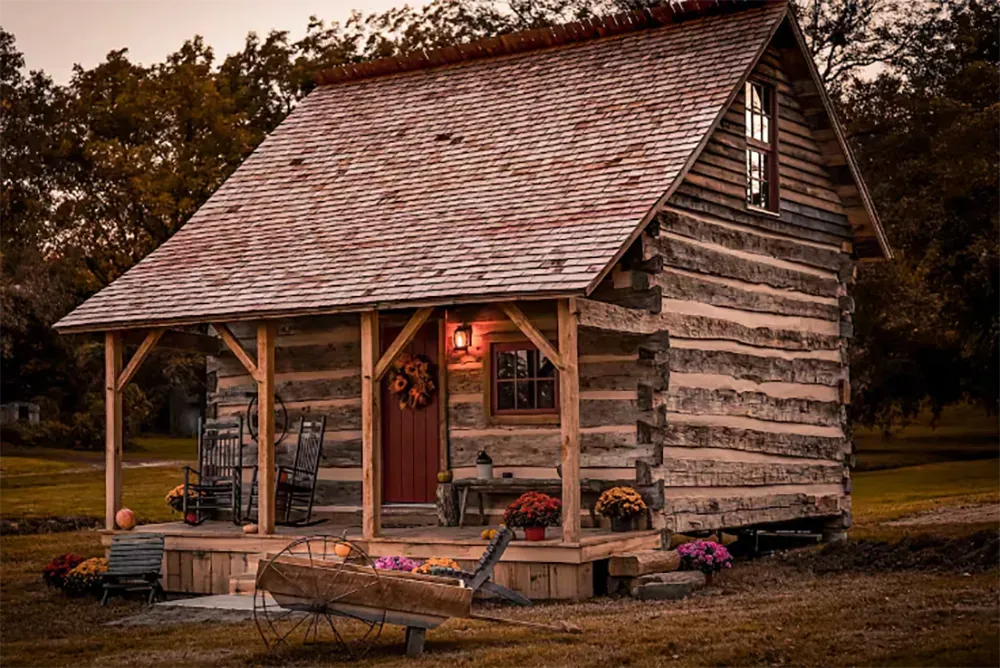
Photo: Sassafras Creek Cabin, St Genevieve MO https://bit.ly/3OcIDOa


